Workshop | Year - 2025 2026 | 19 Jun, 2026
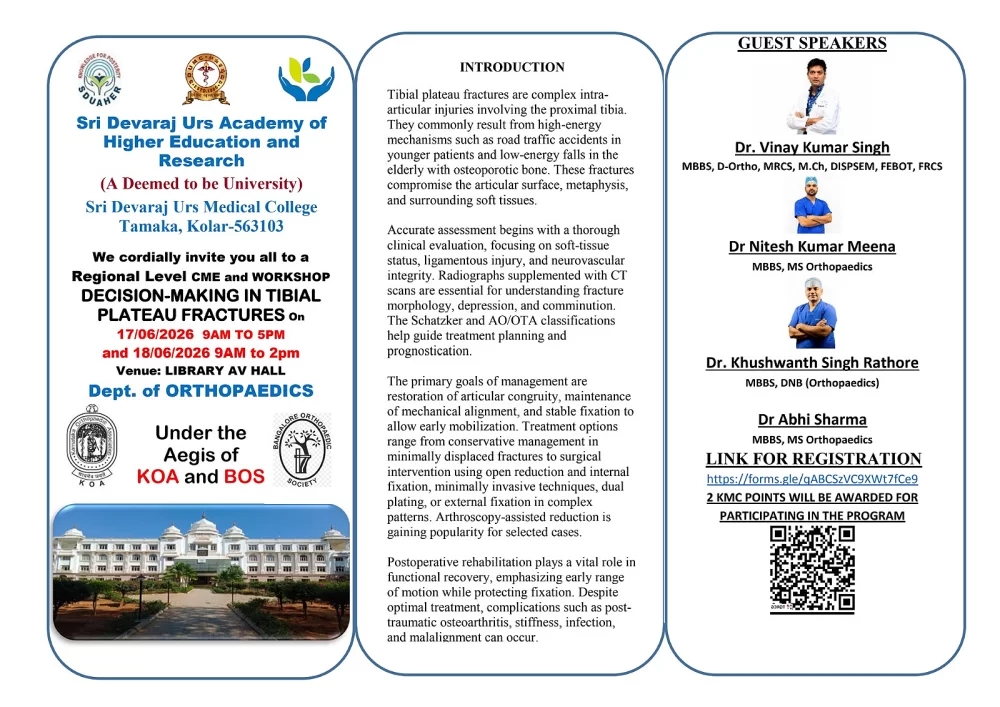
Tibial plateau fractures are complex intra-
articular injuries involving the proximal tibia.
They commonly result from high-energy
mechanisms such as road traffic accidents in
younger patients and low-energy falls in the
elderly with osteoporotic bone. These fractures
compromise the articular surface, metaphysis,
and surrounding soft tissues.
Accurate assessment begins with a thorough
clinical evaluation, focusing on soft-tissue
status, ligamentous injury, and neurovascular
integrity. Radiographs supplemented with CT
scans are essential for understanding fracture
morphology, depression, and comminution.
The Schatzker and AO/OTA classifications
help guide treatment planning and
prognostication.
The primary goals of management are
restoration of articular congruity, maintenance
of mechanical alignment, and stable fixation to
allow early mobilization. Treatment options
range from conservative management in
minimally displaced fractures to surgical
intervention using open reduction and internal
fixation, minimally invasive techniques, dual
plating, or external fixation in complex
patterns. Arthroscopy-assisted reduction is
gaining popularity for selected cases.
Postoperative rehabilitation plays a vital role in
functional recovery, emphasizing early range
of motion while protecting fixation. Despite
optimal treatment, complications such as post-
traumatic osteoarthritis, stiffness, infection,and malalignment can occur.
Registration link:
click here for brochure